Similar Posts
Goodness gracious, great balls of… oxygen?
Well, it was certainly born of fire. This is planetary nebula Abell 39, one of the largest spheres in the galaxy… it’s 2.6 light-years across! It really is that color blue. You’re seeing ionized Oxygen gas blown off by the dying star in its center. Look closely for the distant galaxies in the background, including…
Just an obscure little cloud of hydrogen.
This nebula goes by the unassuming name of SH2-9. It’s part of a larger complex of clouds known as the Rho Ophiuchi complex, but you don’t often see people focusing on this part of it. It’s a challenge to image from my location, as it’s very low in the sky in a light-polluted direction. There…
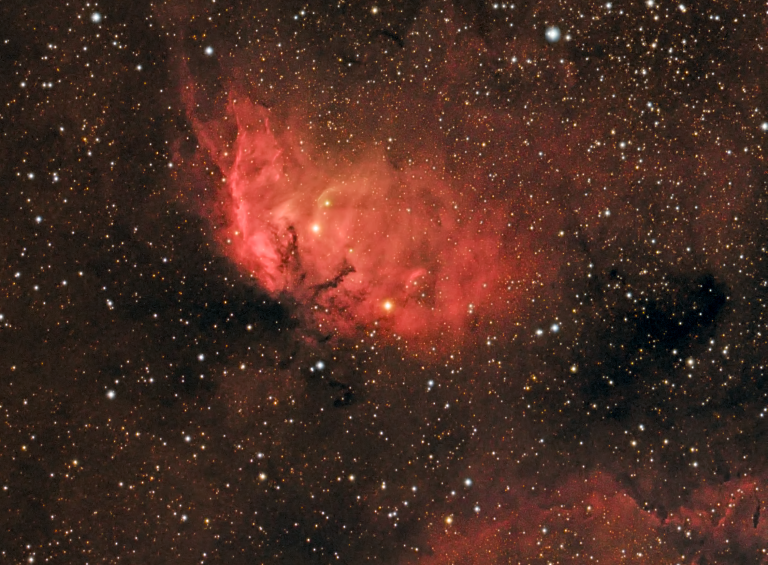
Space Tulip and a Black Hole!
This is the Tulip Nebula in Cygnus, but see that shell-like structure just above it, to the right a little? That’s the bow shock wave of Cygnus X-1, a stellar-mass black hole! It’s one of the most powerful X-ray sources in the sky – but don’t worry, our atmosphere protects you from it. 20 hours…
The Crescent Nebula
Like the Bubble Nebula, and Thor’s Helmet, this is formed by the fast stellar wind of the extremely hot star at its heart – which interacts in complex ways from the wind left over from when this star was a red giant. This is roughly 5,000 light-years away. These images were taken over the span…
The Hickson 44 Galaxy Group
This is a weird little cluster of galaxies – there are four in all, and each one is completely different. There’s a weird, S-shaped one that must have been messed up by its neighbors in the past, a somewhat normal-looking spiral galaxy, and elliptical, and another one that’s viewed edge-on. Galaxies that have interacted with…
Coma Berenices Galaxy Cluster
AKA Abell 1656. There are tens of thousands of galaxies in this portion of the sky; almost everything in this image is an entire galaxy filled with hundreds of millions of stars. Whoah. And they’re hundreds of millions of light-years away. Click and zoom in to explore them all.