Similar Posts
Triangulum Galaxy
Part of our Local Group of galaxies, the Triangulum Galaxy (M33) is about 3 million light years away and the most distant object visible to the naked eye under dark skies.
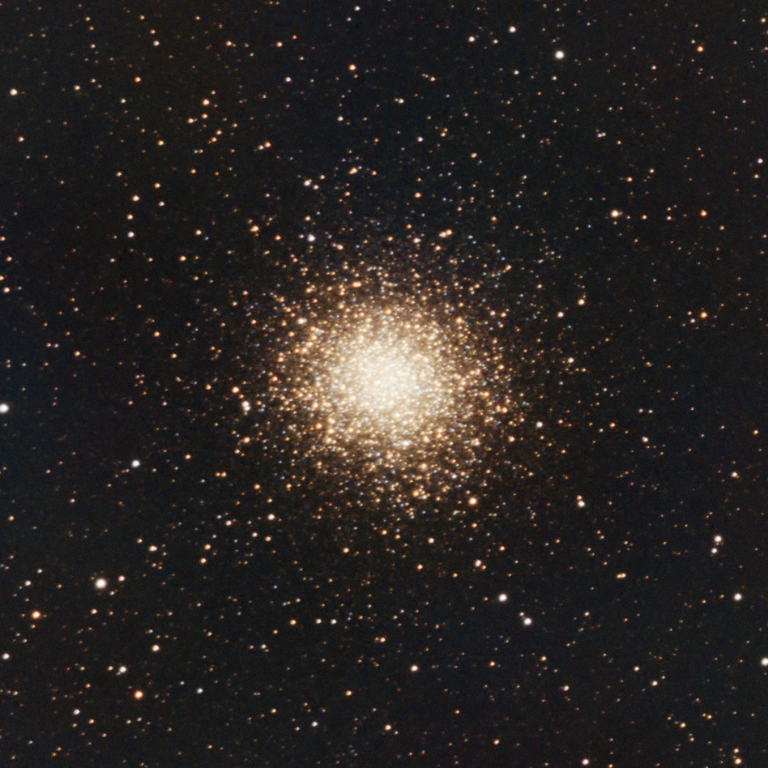
A golden globular cluster: M14
I’ve imaged this one before, but I keep coming back to it because I just can’t believe its golden color is real. But even after applying all I’ve learned about color calibration – I can say pretty definitely that these are its true colors. It’s also benefited from advances in image processing software, making the…
Revisiting M13 in Hercules
M13 is one of the most photogenic and popular globular clusters, and it’s pretty easy to see with nothing more than a pair of binoculars if you know where to look! But it’s even prettier with a long exposure – this is about 3 hours of exposure time. Blow it up to full size, and…
The Witch Head Nebula
Lit up by the bright star Rigel in Orion, the “Witch Head Nebula” is a cloud of dust that reflect blue a little bit more. Unlike emission nebulas that emit their own light from ionized gases, this just reflects the light of Orion – although there *is* some ionized Hydrogen in the background, which you’ll…
Revisiting the Crescent Nebula
I’ve imaged this one before, but for whatever reason I picked up way more detail on it last night. Part of it’s a better camera and better tracking on the telescope mount, but I think conditions may have just been really awesome last night. It’s not normal to have this many good nights for astrophotography…
Looking back to the age of dinosaurs (NGC2336 and IC467)
Spent a couple of nights imaging these distant galaxies; the spiral in the upper-left is NGC2336, and the other is IC467. Galaxies this faint and distant generally don’t have catchy names! NGC2336 is 100 million light-years away. Think about that – you’re looking 100 million years in the past. The light we captured started its…