Similar Posts
Early-morning planetary imaging
We recently obtained a new telescope for observing the planets, and we had our first good conditions for planetary imaging this morning! This is the best image of Jupiter I’ve ever gotten, and I’m hopeful that it will be even better once it gets closer to Earth in a couple of Months. Saturn’s not looking…
The Rosette Nebula
The Rosette Nebula is about 5,000 light-years away in the constellation Monoceros. It’s the birthplace of the cluster of stars it contains. While it doesn’t look much like a Rose in this view, the false-color narrowband image below brings out more of its structure. 7 1/2 hours of total exposure time, on New Year’s Eve…
The Ghost of Cassiopeia
Technically this nebula is called IC63, but its common name “The Ghost of Cassiopeia” seems much more timely, given Halloween is just around the corner! Imaged all night last night, mostly in true colors with some Hydrogen emissions added in to enhance it.
The Dumbbell Nebula
The Dumbbell Nebula (M27) is what’s called a planetary nebula – but it has nothing to do with a planet. This shell of gas was blown out by a dying star; once it started to run out of Hydrogen to burn, it expanded and blew out the gases you see here. The star then collapsed…
The Sun is Looking Angry Today
That massive sunspot group rivals the size of the one that triggered the Carrington Event in 1859. So far it has kicked off some large coronal mass ejections heading our way, but fortunately nothing on that scale. Let’s hope we just get some pretty auroras from this, and nothing more damaging!
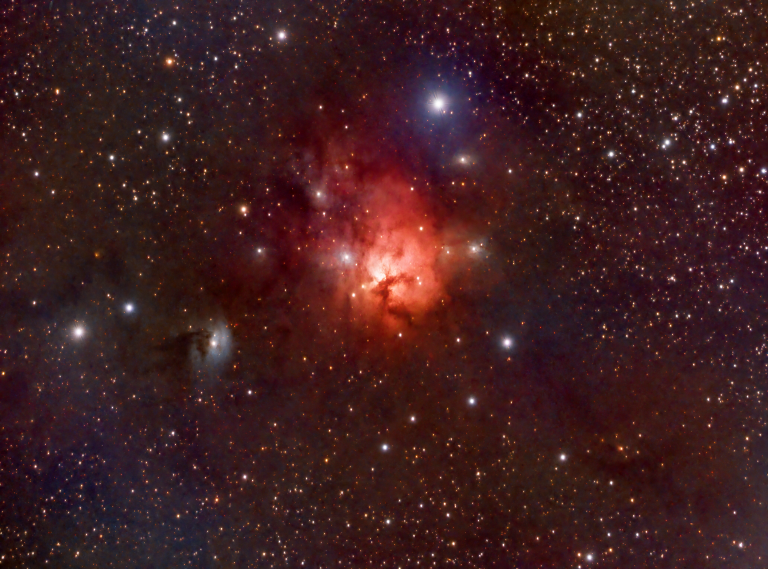
The Northern Trifid Nebula
Formally NGC1570, the “Northern Trifid” is a combination of an emission nebula (the red parts, which is ionized Hydrogen emitting its own light) and a reflection nebula (the blue parts, which is starlight reflecting off dust.) You can also see hints of the dust surrounding this area, which is difficult to capture under the light-polluted…