Similar Posts
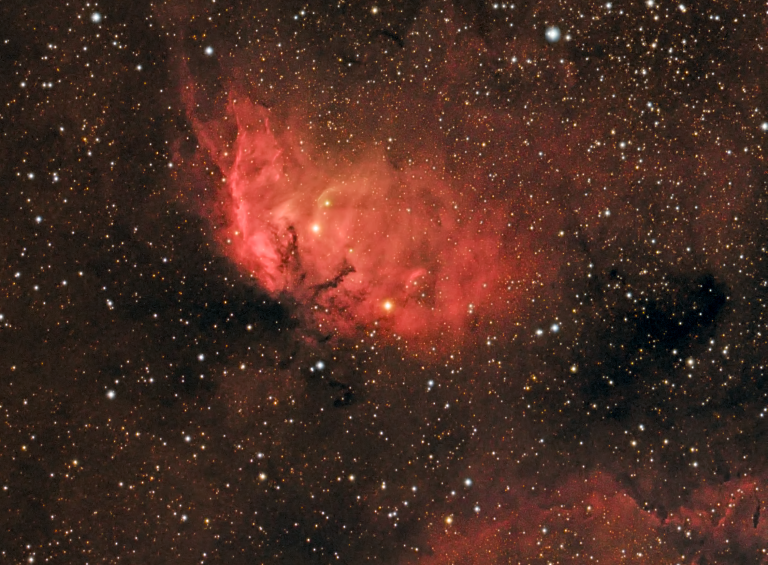
The Flaming Star Nebula
I shot this object in a few different ways. Here’s how it looks in pure “LRGB” light – how it would appear to the eye in its natural wavelengths, if your eyes could detect color on something so dim! And here’s a narrowband take on this same object. Notice that the structure of its core…
Melotte 15
This young star cluster inside the Heart Nebula is lighting up the clouds of gas from which it formed. 3 hours of narrowband exposure from my suburban driveway.
Space Jellyfish!
This is IC443, commonly known as the “Jellyfish Nebula” for obvious reasons! IC443 is a supernova remnant about 5,000 light-years away. This is a false-color, narrowband image consisting of a total of 20 hours of exposure time.
Revisiting M106 and the Sunflower
Now that our new backyard observatory is up and running, and we’re under darker skies than in our previous home, I’m revisiting some galaxies I’ve imaged before to see how things compare. Galaxies are tough… any amount of light pollution or moonlight really limits your ability to capture faint, wispy details. But the less light…
The Pelican Nebula
Granted this is only a portion of it, but for the life of me I don’t see a pelican in this thing. But, it’s still pretty. I processed this object two ways: using the “Hubble palette” that maps red, green, and blue to Sulfur, Hydrogen, and Oxygen emissions (that results in the pretty blue one)…
The Baby’s Bottom
This is a small part of a larger nebula called the “Baby Nebula” (also known as the Soul Nebula) in the constellation Cassiopeia. If you see a baby in the larger nebula this is part of, this image would be of the baby’s bottom đŸ™‚ There is a ton of star formation going on in…