Similar Posts
Globular Cluster M15
Located about 33,600 light-years away within the constellation Pegasus, Messier 15 is a globular cluster – a tight, ancient ball of stars on the outskirts of our galaxy. The Milky Way is surrounded by many such clusters; this one’s special because it’s known to host a rare intermediate-sized black hole at its center, and it…
Revisiting the Northern Pinwheel Galaxy (M101)
Somehow I’ve neglected to go back to one of the showcase galaxies of the spring sky with newer equipment and software: M101, the “Pinwheel Galaxy.” Located about 21 million light-years away within Ursa Major, this relatively close galaxy shows lots of active star-forming regions revealed by red HII gas. Those red spots are nebulae in…
Space Jellyfish!
This is IC443, commonly known as the “Jellyfish Nebula” for obvious reasons! IC443 is a supernova remnant about 5,000 light-years away. This is a false-color, narrowband image consisting of a total of 20 hours of exposure time.
The Cave Nebula
Formally SH2-155, the Cave Nebula lies about 2,400 light-years away within the constellation Cepheus. It’s part of a much larger region of gas and dust (called a molecular cloud). This region is mostly ionized Hydrogen, but there’s just enough Oxygen – blue in this image – to make for a pretty picture. Capturing that Oxygen…
A Star Cloud in Another Galaxy
NGC206 is an unusual object. It’s a cluster of stars, which in itself is not unusual at all… but it’s in ANOTHER GALAXY. The Andromeda Galaxy, to be precise. The fact that we can see it so clearly, two and a half million light-years away, boggles the mind. It’s that cluster of blue stars near…
Off to See the Wizard (again)
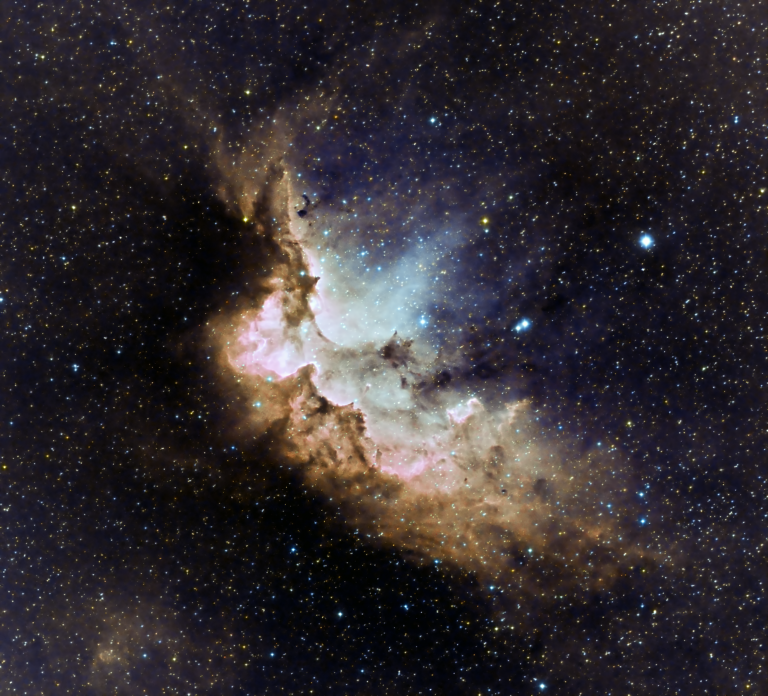
These past couple of nights, I revisited the Wizard Nebula – home of a star cluster about 7,000 light-years away within the constellation Cepheus. This is a false-color image in the “Hubble Palette” where red, green, and blue represent ionized Sulphur, Hydrogen, and Oxygen emissions respectively. Can you see the “wizard”? Hint: he’s lying on…