Similar Posts
The Nebula with No Name
This dim nebula in the constellation Perseus has no name, apart from its catalog numbers NGC 1491 and LBN 704. I think it deserves one. It reminds me of the Bubble nebula – if you look closely, you’ll see a “bubble” at center being created from the stellar wind of the hot star that is…
Going Back to Cali
Both on Earth, and in space! While we prepare for a year or two in California, I trained Scopey von Scopington on the California Nebula for a few nights. Pretty obvious how it got its name! This is a two-panel mosaic, consisting of narrowband SHO data for the nebula and broadband RGB for the stars….
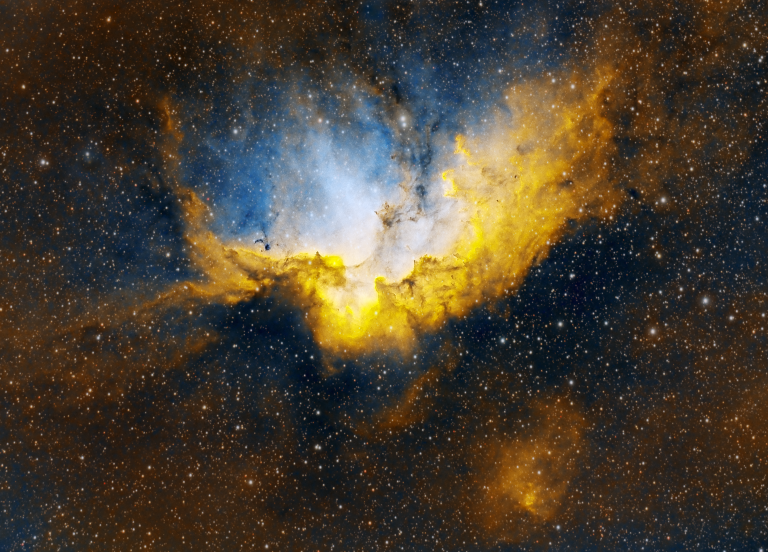
The Witch Head Nebula
Lit up by the bright star Rigel in Orion, the “Witch Head Nebula” is a cloud of dust that reflect blue a little bit more. Unlike emission nebulas that emit their own light from ionized gases, this just reflects the light of Orion – although there *is* some ionized Hydrogen in the background, which you’ll…
Late-night planetary imaging.
Imaging the planets requires completely different techniques and equipment than deep-sky stuff, and it’s something I’m not really good at yet. What matters the most is the seeing conditions – how stable the atmosphere is. A big part of taking good planetary images is just having the perseverance to get out there whenever the seeing…
The Heart of the Heart Nebula
The Heart Nebula is a little too big to fit within the field of view of my telescope, but its inner “heart” is interesting in its own right. This is star cluster Melotte 15, formed from the gases within the Heart Nebula – and some of that gas remains, forming interesting clouds and formations where…
A “ring galaxy” 600 MILLION light-years away
Hoag’s Object is the weirdest galaxy I know of; it is a “ring galaxy” – a very rare galaxy type that’s just a galactic core of stars, surrounded by a ring of stars that’s seemingly disconnected from its core. This galaxy has always captured my imagination. Just look at this image from the Hubble Space…